
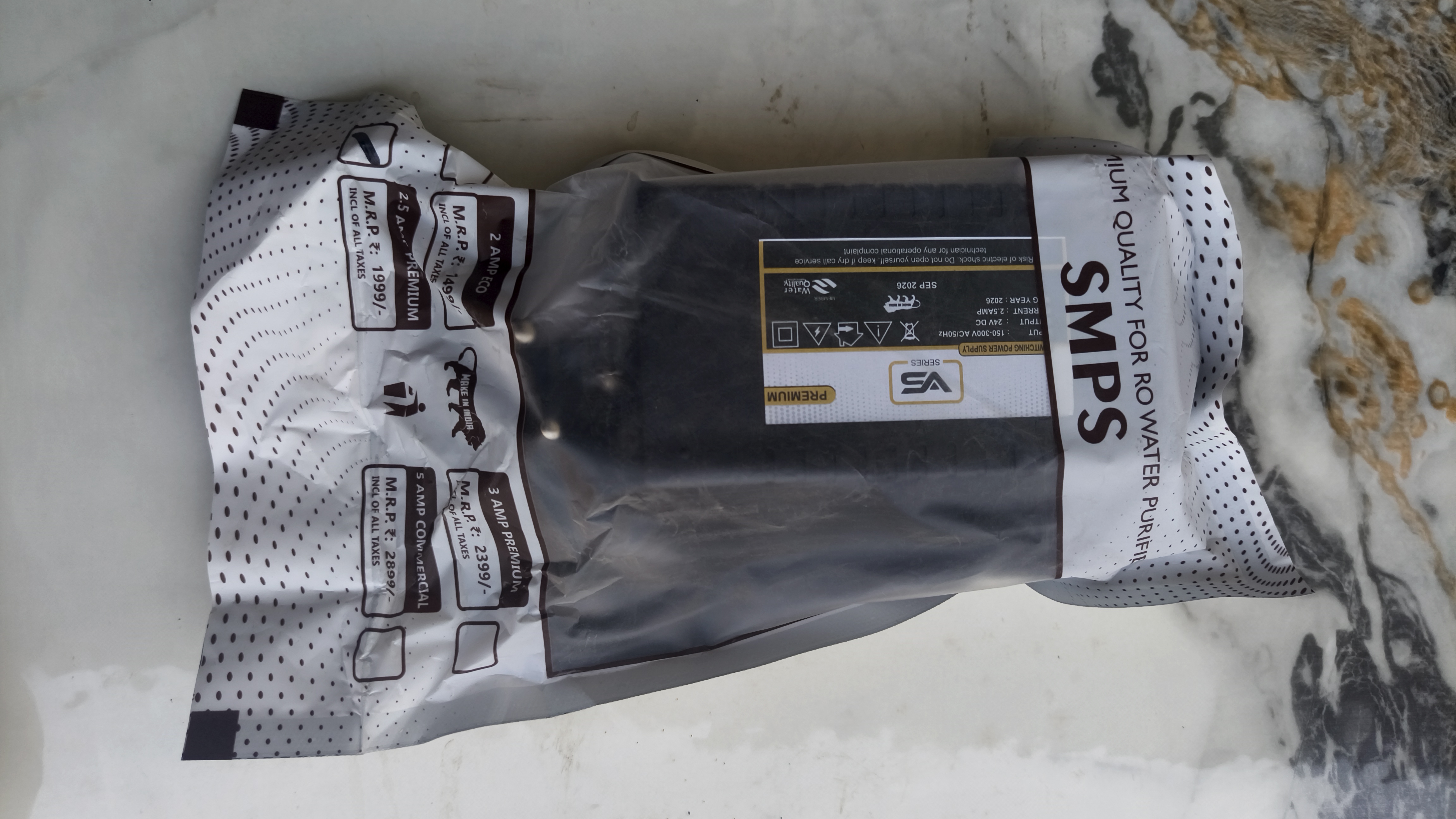
Understand what the power supply does
An RO power supply converts incoming electricity into the output required by compatible pumps, valves, or control electronics. SMPS means switched-mode power supply, a common design used in adapters. It does not describe one universal voltage or guarantee suitability for every purifier. Begin with the system’s specified replacement part.
A purifier that will not start does not necessarily have a failed adapter. The cause could be the outlet, wiring, pressure controls, a pump, or a controller. Avoid ordering a supply solely because the pump is silent. Any electrical diagnosis must account for the presence of water.
Read both input and output labels
The input rating must match the local electrical supply and installation conditions. The output must match the required voltage and AC or DC type. For DC equipment, polarity is also critical. Do not assume that every purifier uses the same low-voltage arrangement.
Current capacity must be adequate for the connected equipment, including manufacturer-specified startup requirements. A higher current-capacity rating alone does not make a supply incompatible when all other required characteristics match, but it does not prove compatibility either. Regulation, protective features, connector arrangement, and approval for the application still matter.
For example, replacing a specified 24-volt DC supply with a 12-volt adapter because its plug fits is not a safe troubleshooting shortcut. Likewise, a nominally correct voltage does not compensate for reversed polarity or an unsuitable connector.
Check the connector and the complete load
Barrel plugs can differ in outer diameter, inner diameter, insertion length, and polarity. Other systems use keyed connectors or harnesses with specific pin assignments. A loose connection may interrupt operation, while an incorrect wiring arrangement can damage equipment. Identify the documented connector rather than relying on visual similarity.
Check what the supply powers. A pump-only replacement calculation may overlook a solenoid valve or controller on the same supply. Use the manufacturer’s complete-system requirement instead of adding uncertain label values and assuming the result is sufficient.
Keep electricity away from leaks
Use an approved supply with appropriate electrical-safety compliance for the market and installation. Place it as instructed, protected from drips, condensation, and excessive heat. An enclosed plastic case is not necessarily waterproof. Do not hide an adapter where a small leak can soak it unnoticed.
Never open a mains-powered adapter to inspect or repair it. Internal capacitors may retain hazardous energy after unplugging. Burn marks, a damaged cord, melting, persistent unusual odor, or exposed conductors are reasons to stop using the unit and obtain qualified help.
Replace and test without bypasses
Disconnect power from a safe, dry location before handling connections. Resolve any water leak first. Do not splice mains wires, defeat grounding, bypass protective controls, or use an improvised multi-adapter chain to make a replacement fit.
After fitting an approved replacement, confirm stable operation through a normal production and shutoff cycle. Stop if the supply becomes abnormally hot, the pump repeatedly stalls, or connections behave intermittently. Document the replacement model and ratings. When labels are missing or wiring has already been modified, professional identification is safer than trial-and-error substitution.
Browse compatible parts
Browse the V Drop product catalogue and share your existing part label when asking about compatibility.